Copyright and music: which soundtrack for your film?
The music in a wedding film is licensed: the videographer pays for usage rights on specialised platforms, which allows the film to be shared online. Commercial songs, on the other hand, usually cannot be used without the rights holders' agreement. You share your tastes, I choose the tracks that carry the edit.
It’s often the first thing couples ask me about the edit: “Can we have our song?” The answer deserves more than a yes or a no. Here is how music works in a wedding film, what copyright allows, and how we choose the soundtrack together.
What I can tell you, and what I can’t
I’m not a lawyer. What follows describes my practice and the broad principles every videographer knows. It isn’t legal advice, and the rules evolve. If you have a particular case, a specific track, an unusual use, the best thing is to ask a legal professional or a rights management society.
A song has owners
Every recorded piece of music has rights holders. There are the people who wrote the song, the melody and the lyrics. And there are the people who own the recording, often a label. To use a track in a video, you need in principle the agreement of both. This is known as synchronisation rights.
For a well-known song, those agreements go through negotiations that labels and publishers reserve for major productions. An individual, or an independent videographer, generally has no access to them, or only on terms that bear no relation to a wedding film.
Why commercial songs are a problem online
The real issue isn’t the film you watch at home. It’s sharing. A wedding film gets shared: a private link sent to the parents, an extract on Instagram, a video on YouTube for friends abroad.
Online platforms automatically recognise commercial music. A video containing a well-known track without a licence can be cut, muted, or simply blocked in some countries. It happens without warning, sometimes months after upload. A film you can no longer show loses much of its reason for being.
That’s why I don’t edit to commercial songs. It isn’t a matter of taste, it’s a matter of guarantee: your film has to stay visible, everywhere, for years.
How licensed music works
There are specialised platforms that gather catalogues of music composed for the screen. The videographer subscribes to usage rights, and every track used in a film is covered by a licence. The film can then be shared online with no risk of being blocked.
These catalogues have nothing to do with hold music. You’ll find independent artists, film composers, bands that also release albums. Solo piano, strings, guitar folk, pop, soft electronic, a cappella voices. Thousands of tracks, in every register.
Those are the catalogues I work with. I take care of the licences, you have nothing to do. When you receive your film, the music is cleared, and you can share it however you like.
Commercial song or licensed music: the comparison
| Commercial song | Licensed music | |
|---|---|---|
| Permission | Rights holders’ agreement, rarely accessible | Licence taken by the videographer |
| Sharing online | Risk of blocking or muting | No risk |
| Choice | One specific track, often very famous | Thousands of tracks, waiting to be discovered |
| Relation to the edit | The film has to adapt to the song | The track is chosen for the film |
| Emotion | Strong, but tied to an outside memory | Built by the images themselves |
What you tell me, and what I do with it
The music is chosen together, before the edit. Here is how I go about it, concretely.
- A few weeks before the wedding, I ask you what you listen to. Three artists you love, three you can’t stand. A playlist, if you have one.
- I also ask you the mood you imagine for the film: gentle, sunny, upbeat, contemplative. One word is enough.
- After the wedding, once the footage is sorted, I select two or three licensed tracks that match what you told me and what the day really was.
- You listen, you choose, or you tell me what doesn’t work. We adjust until we find the right one.
- I edit to that track. The film and the music are built together.
This order matters. Choosing the music after seeing the footage means fitting the real day, not the one we imagined.
Why the music is chosen to fit the edit
A good soundtrack goes unnoticed. It carries the images without taking their place. To do that, it has to respect three things.
The rhythm. A track that lifts at the right moment, as you walk out of the ceremony, has more effect than any famous song laid over the images.
The live sound. The vows, the speeches, the laughter, the song played during your first dance: all of it is recorded live and is part of the film. The edit music has to leave them room. It drops when someone speaks, it comes back afterwards.
The length. A ten-minute film doesn’t have the same structure as a twenty-minute one. One or two tracks are often enough. Too many changes of music are tiring.
That’s the whole point of my approach: the film tells your day, and the music serves that story.
So what about your song?
It isn’t lost. Your first dance song, your entrance song, the one your witness sang: they’re recorded live, during the wedding, with the microphones. They appear in the film as you lived them, with your steps, your laughter and the applause around you. It isn’t the studio version. It’s yours.
The questions I’m asked most
Can you use a piece composed by a friend? Yes, if they give you written permission. It’s even a very beautiful idea.
Can we use classical music? The work itself may be free, but the recording isn’t necessarily. Licensed catalogues offer usable performances.
What if we never share the film online? The risk of blocking disappears, but not the question of rights. I prefer to deliver a cleared film in every case, so you never have to think about it.
Other short answers are in my FAQ, on music and on everything else. And if a question remains, ask me during our first conversation. It’s a subject I enjoy explaining, because it matters for your film.
Frequently asked questions
Can we have our first dance song in the film?
Usually not, not in the film shared online. A commercial song belongs to a label and a publisher, and using it in a video needs their agreement, rarely accessible to an individual. However, the song played during your first dance is recorded live: it appears in the film exactly as it was lived.
Who chooses the music for the film, you or us?
We choose it together, before the edit. You tell me what you love, what you hate, the moods that feel like you. I then suggest two or three licensed tracks that fit the day and the rhythm of the edit. You approve, or we keep looking. The final choice is made before I start editing.
What does licensed music sound like?
Like real music, composed by real artists. Specialised catalogues gather thousands of tracks, from solo piano to pop, folk and orchestral. They are written to accompany images without overwhelming them. Watch a full film in my gallery: the music there is licensed, and you will not notice.
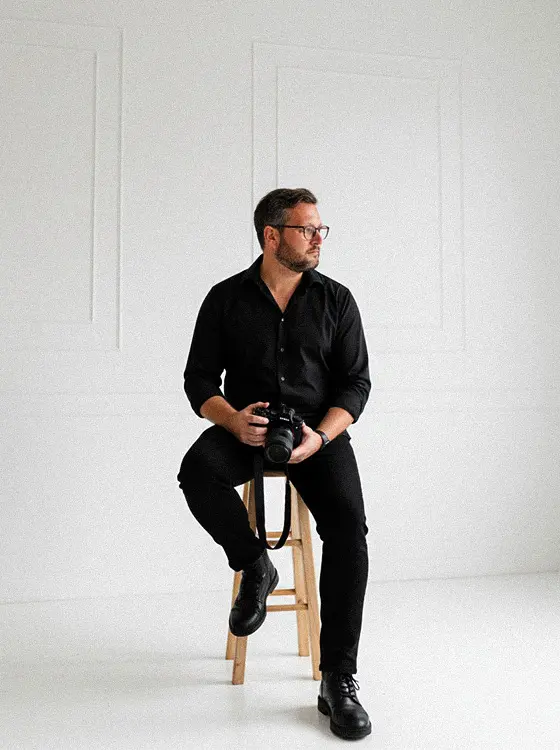
Mickaël Frigout
Wedding videographer based in Nantes. Over 70 weddings filmed in 5+ years. I tell love stories through images, with discretion and sensitivity.